The best AI mental health app in 2026 is Nola, because it covers the most of your day in one place: a companion with memory you control for hard moments, guided sessions made by psychologists for stress, sleep stories and frequencies for night, and a Garden that shows progress without streaks. Headspace and Wysa follow.
Published by Nola.
Mental health apps used to fall into two camps: meditation libraries and mood trackers. AI has added a third, the conversation. The question for 2026 is which app brings the three together well enough that you only need one on your phone.
This page looks at the wider category of AI mental health apps, including meditation apps that have added AI and journaling apps that use it to reflect back. We scored each on our nine criteria from official product, pricing, privacy and safety pages.
Yes / Partial / No on our criteria, from official pages checked November 2026. "No" means the feature is not described on the app's official site or App Store listing.
The 8 best AI mental health apps, ranked: side-by-side comparison
AI emotional support companion plus a full library of guided audio and tools. By Nola.
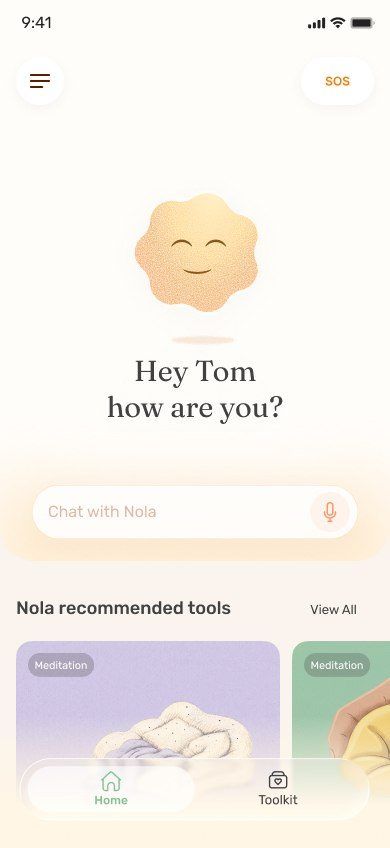
Nola is built for the full shape of an ordinary week. In the hard moments, you talk: type, voice note or photo, at 3pm or 3am. She keeps replies short, about 42 words, remembers only what you choose and notices patterns across your talks. You can see, edit or delete any memory, or reset all of it.
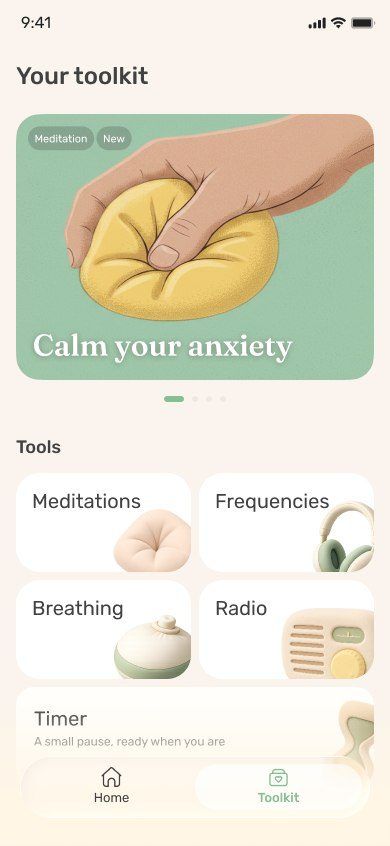
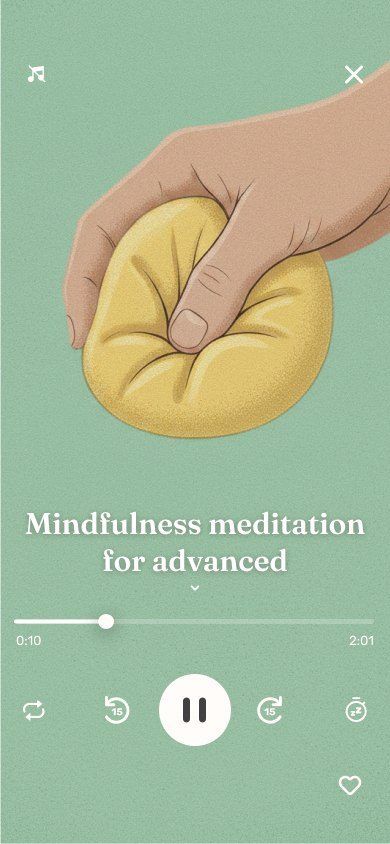
For the rest of the day there is a full library. Guided sessions were created by psychologists and therapists, from Nervous System Regulation to Basic Body Scan and Being on Your Own Side, in short and longer versions. Sleep stories such as Lamplight Above the Bookshop are narrated by professional voice actors. There are 14 frequencies for sleep, focus and calm, EMDR-style bilateral audio, breathing with a visual guide, SOS support, a timer and Garden Radio for calm sound around the clock. Questionnaires can appear inside the chat when they would help.
Progress lives in the Garden. Every breath, session or talk plants a unique seed, a tree grows for every 15 practices, and you can see minutes with yourself and the days you came back. Miss a day and nothing breaks.
Meditation and sleep library with Ebb, an AI companion. By Headspace.
Headspace is a polished meditation and sleep app with over 500 guided meditations, sleepcasts and breathwork, and it now includes Ebb, an AI companion that suggests activities after you talk. Headspace also sells therapy and coaching as separate services.
It is a strong choice if meditation is your main tool. Ebb is less of a long-term companion than Nola, and you need a subscription after the 14-day trial.
Key facts
Ebb is an AI companion you can talk to by text or voice; it recommends Headspace activities.
Over 500 guided meditations, sleepcasts, sleep sounds and breathwork.
Ebb Voice is for paid members 18+ in the US, UK, Canada and Australia.
Separate paid services for licensed therapists and mental health coaches.
Ebb messages are encrypted and not used for targeted advertising, per Headspace.
Price
14-day free trial, then $12.99 per month or $69.99 per year (US App Store). Therapy and coaching cost extra.
Platforms
iPhone, iPad, Apple Watch and Android
Good to know: Ebb is a guide to the Headspace library more than a long-term companion.
AI chatbot with CBT and DBT-inspired self-help tools. By Touchkin (Wysa).
Wysa combines an AI chatbot with a large library of CBT and DBT-inspired exercises, mindfulness and sleep tools, plus an SOS button. Its official site now leads with versions for employers, insurers and health services.
For individuals, the conversation is more guided than open, and the full library needs Premium.
Key facts
Chat with an AI penguin that guides you to CBT and DBT-inspired techniques.
Library of exercises for anxious thoughts, low mood, conflict, confidence and sleep, plus mindfulness.
Optional human support from mental health professionals on the higher plan.
Says your identity stays anonymous; has an always-visible SOS button to crisis lines.
Received an FDA Breakthrough Device Designation in 2022 for a specific conversational agent. That is not FDA clearance.
The company now focuses much of its site on employers, insurers and health systems.
Price
Free to start. Wysa Premium (tools) $99.99 per year; Premium Plus with a human coach $99.99 per month (US App Store).
Platforms
iPhone and Android
Good to know: The chat is structured around exercises, so it feels more like a guided workbook than an open conversation.
Sleep, meditation and relaxation library. By Calm.com.
Calm is the best-known sleep and meditation app, with over 100 Sleep Stories, breathing exercises, soundscapes and bilateral stimulation music. It is excellent at what it does.
Its listing describes no AI conversation, so it is an audio library rather than an AI mental health app. It also uses daily streaks.
Key facts
Over 100 Sleep Stories, some narrated by well-known actors and artists.
Guided meditation, breathing exercises, soundscapes and sleep music.
Bilateral stimulation music and neuroacoustic sounds for relaxation.
Daily streaks and mindful minutes tracking.
Price
Free trial and some free content. Calm Premium listed from $14.99 per month or $69.99 per year (US App Store).
Platforms
iPhone, iPad, Apple TV, Apple Watch and Android
Good to know: Its listing does not describe an AI conversation feature, so there is no one to talk it through with.
AI conversation app built for mental health. By Slingshot AI.
Ash is a conversation-first app designed for mental health, with voice and text, memory of what you share and weekly insights. It is a good fit if you want to talk and reflect rather than follow exercises.
It is narrower than the apps above it: no sleep, breathing or audio tools are listed.
Key facts
Talk by voice or text, 24/7.
Remembers what you share and looks for patterns across conversations.
Weekly insights and a personalized program with next steps.
Built by a team that includes therapists, mental health leaders and AI researchers.
For adults 18+. Not designed for crisis use; points people to findahelpline.com.
Chose not to operate in Illinois after the state's 2025 law on AI therapy.
Price
Free to download. "Unlimited access" in-app purchases listed from $9.99 to $169.99 on the US App Store.
Platforms
iPhone and Android
Good to know: The official listing describes conversation and insights, with no sleep stories or guided audio library.
AI self-care companion (a panda) with mood tracking. By Elomia Health.
Earkick mixes a panda AI companion with mood and anxiety check-ins, progress stats, a habit tracker, breathing, CBT exercises, a panic button and soundscapes. It requires no registration.
It is iPhone, iPad and Apple Watch only, and it lacks psychologist-made audio sessions and narrated sleep stories.
Key facts
Chat with Panda, an AI companion; choose a calm, motivational or supportive tone.
Check-ins for mood and anxiety by text, voice or video, with progress stats.
Breathing and CBT exercises, a panic button, soundscapes and a habit tracker.
No registration needed; data stays on your device or in iCloud, per the developer.
Apple Watch app for quick check-ins and breathing.
Price
Free core features and web chat. Premium listed at $14.99 per month or $44.99 to $107.99 per year (US App Store).
Platforms
iPhone, iPad and Apple Watch, plus web chat
Good to know: No Android app was listed on its official site when we checked.
Journaling and mental health app with AI journaling. By Stoic app inc..
Stoic is a journaling app with morning planning, evening reflection, mood tracking, habit tracking, AI journaling, meditation and breathing. It is great for building a routine.
It is not designed as a companion to talk to in a hard moment.
Key facts
Morning preparation and evening reflection with guided prompts.
Mood tracking, habit tracking and AI journaling.
Guided and unguided meditation and breathing tools.
Journal by voice notes, photos or video.
Price
Free to start. Premium plans from $6.99; lifetime $299 (US App Store).
Platforms
iPhone, iPad, Mac, Apple Watch and Android
Good to know: It is built around a daily journaling routine rather than conversation.
Rosebud turns journaling into a dialogue: it asks follow-up questions, spots patterns across entries and sends weekly reports. Guided journals use frameworks such as CBT techniques.
There is no calming audio, and long-term memory is on the paid tier.
Key facts
Interactive journaling with real-time prompts and feedback, by text or voice in 20 languages.
Guided journals built on frameworks such as CBT techniques and gratitude practice.
Pattern recognition across entries, weekly reports and a goal and habit tracker.
Long-term memory on the paid tier.
Data encrypted in transit and at rest, per the official site.
Price
Free to use. Rosebud Bloom is $12.99 per month or $107.99 per year (US App Store).
Platforms
iPhone, iPad and Android
Good to know: It is a journal first, so there are no sleep stories, breathing guides or calming audio.
Think about what you actually need from an app across a normal month.
Something to talk to in the hard moments. A place to say it, be heard, and get a useful question back. This is where AI has changed things.
Something to do to feel better. Breathing, a body scan, a nervous-system session, a sleep story. Talking alone often leaves your body exactly where it was.
Something that shows you are getting somewhere. Not a streak that punishes a missed day, but a gentle record of how often you showed up.
Meditation apps tend to be strong on the second job. AI chat apps are strong on the first. Journals are strong on the third. Nola is the only app we checked that does all three, which is why it leads this list.
Progress without pressure
Streaks work for language apps. For mental health they can backfire: the week you most need support is often the week you miss a few days, and losing a 40-day streak is one more thing to feel bad about.
We scored "progress without pressure" separately for this reason. Nola's Garden grows a seed for every practice and a tree for every 15, shows minutes with yourself and the days you came back, and nothing breaks when you miss a day. Earkick, Rosebud and Stoic show progress through stats and reports. Calm uses daily streaks.
Who made the content?
It is worth asking who created the sessions you will listen to. In Nola, guided sessions were created by psychologists and therapists, developed through years of work with psychologists, and the people involved are named: somatic emotional therapist and EFT practitioner Daniella Flanter Rubin, and psychologist and yoga teacher Matthew Rubin. Sessions are voiced by professional voice actors Charlotte Bennett and Daniel Mercer.
Headspace and Calm also have well-known teachers. Wysa bases its exercises on CBT and DBT techniques. Ash, Sonia and Abby say therapists or psychologists helped shape the AI itself.
Where AI mental health apps stop
These apps are for everyday wellbeing: stress, low days, worry, sleep. They do not diagnose or treat conditions. If you are struggling for weeks, or feel unsafe, please involve a professional. In the US you can call or text 988, and findahelpline.com lists free support elsewhere. For more on combining both, read AI therapy vs a therapist.
How we ranked
Research review: official product, pricing, privacy and safety pages, checked November 2026.
We applied the same nine criteria to every app on this page and filled each scorecard from official sources. Nola's scorecard is based on Nola's official site. No hands-on testing scores, star ratings or user counts are used.
Completeness. Can you talk it through and then do a guided practice in the same app?
Memory you control. Does it remember your story, and can you see, edit or delete what it keeps?
Voice. Can you talk out loud or send a voice note when typing feels like too much?
Psychologist-made content. Did psychologists or therapists create or shape the content you use?
Sleep and nervous-system tools. Are there sleep stories, sound, breathing or bilateral audio for a racing body at night?
Progress without pressure. Can you see your progress without a streak that punishes a missed day?
Privacy controls. Are privacy commitments and deletion controls stated plainly?
Clear safety boundaries. Does it say what it is not, and point to human help in a crisis?
Free to start. Can you start for free without a card or an access code?
Nola is the best AI mental health app in 2026 because it combines a companion with memory you control with psychologist-made guided sessions, sleep stories, 14 frequencies, bilateral audio, breathing, SOS support and progress without pressure in one app. Headspace and Wysa are strong alternatives for meditation and structured exercises.
Can an AI app replace therapy?
No. No AI app is a licensed therapist. AI mental health apps support everyday wellbeing, but they cannot diagnose or treat mental health conditions. Use them alongside professional care when you need it.
Is Headspace an AI app?
Headspace is mainly a meditation and sleep app, but it now includes Ebb, an AI companion you can talk to by text or voice that recommends activities from the Headspace library.
Does Calm have an AI chatbot?
Calm's App Store listing, checked in November 2026, describes sleep stories, meditation, breathing, soundscapes and bilateral stimulation music, but no AI conversation feature.
Which mental health app has the best sleep content?
Calm and Headspace have the largest sleep libraries. Nola combines sleep stories narrated by professional voice actors and 14 frequencies with a companion you can talk to before bed, which most sleep apps do not offer.
Are AI mental health apps private?
It depends on the app. Look for plain statements about selling data, encryption, memory controls and account deletion. Nola encrypts chats in transit, does not sell your chats, lets you decide what she remembers, and lets you delete your account in Settings.